

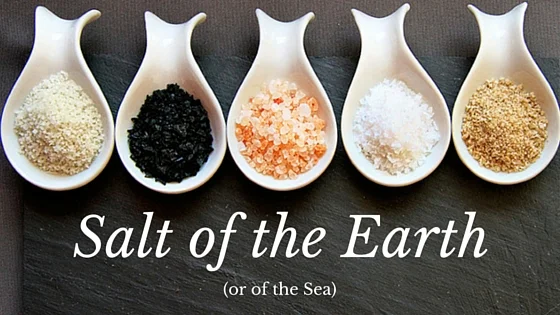
Chocolate. Coffee. Olive oil. Balsamic vinegar. Cheese. And yes even salt all now have “designer” versions. It makes my mouth water just thinking about them! The packaged, bland varieties available to us for so long are now being challenged by prettier, tastier, and healthier options.
As an aficionado of the specialty food movement, my goal is to break down these options and explain the benefit to your health and your table that makes the price of the gourmet versions of your food a worthwhile investment in pleasure and living well. Today, we’ll focus on salt.
Until recent years, our old friend-in-blue Morton graced most of our tables. Now even our neighborhood grocer has a growing variety of salts from kosher to rock to sea pushing the lowly table salt to the bottom shelf (Siberia in grocery store shelf positioning).
The opinions on the topic of table vs. sea salt are wide and varied. There are many who argue against buying into the designer salt craze simply because table salt and sea salt have identical chemical components. They might concede that sea salt has a few more trace minerals that are, okay, good for us, but then add the fact that table salt has iodine added to it which is of course a very important nutritional supplement critical to the function of our thyroid. Generally, while all agree that sea salt tastes better and has a better texture, some argue that once it dissolves into your food, it’s all the same making the cost of sea salt unjustifiable.
I’m on the side of the debate that emphasizes taste, texture and natural minerals. Due to a childhood kidney ailment, I didn’t use any salt for almost 25 years, so I never developed a taste for table salt (or any salt for that matter). One day a friend brought me an elegant little container of Fleur de Sel from her trip to France. I thought “what the heck, I’ll give it a try even though I don’t like salt. After all it’s French so it must be something special.” So I did. And after 25 years of no salt, to me this delicate flavor, light crunch and salty spikes of Fleur de Sel was the culinary equivalent of a black and white movie being converted to color. I was truly amazed at the richer flavor of food.
Once the souvenir salt ran out, I tried using table salt to see if it had the same effect. There was no comparison. Table salt has an unpleasant bitter metallic taste to me.
Sea Salt vs. Table Salt
Sea salt comes in a wide variety of natural flavors derived from the area of the world from which it is harvested. I much prefer that sea salt is harvested while table salt is processed. Doesn’t that tell us something.
Sea salt is made from evaporated sea water. The only thing ever added to sea salt is flavoring like rosemary or lemon. Sometimes sea salt is cold-smoked, like the luscious and rich Halen Môn from Wales. Table salt on the other hand has a number of additives. Are you ready for this?
In addition to iodine, added in 1924 to prevent goiter, table salt is also enhanced with Yellow Prussiate Na4Fe to prevent clumping. This chemical contains cyanide. Those proponents of the use of table salt were quick to argue that there is so little of this ingredient that it can’t hurt us. Hummmmm. Table salt also contains dextrose, a simple sugar like glucose, used to stabilize the iodine. The ingredient label on sea salt reads ‘salt’, which is simply derived from evaporated sea water. That’s it.
All salt provides useful and important health benefits. For too long we were warned against eating any salt, similar to the no-fat craze. In addition to being an austere and flavorless way to live, our bodies need some fat, just as it does salt. Here are a few ways that salt benefits our bodies:
· Salt helps in the preservation of melatonin and serotonin, hormones very useful in fighting the physical effects of stress.
· Salt can help you sleep better (take with a glass of warm water or honey at night)
· Salt aids the absorption of food into your bloodstream
· Contrary to long-ago disputed reports, it actually helps to regulate blood pressure
Both table salt and sea salt will provide these health benefits. However, table salt is only able to deliver along with it’s not-so-healthy or appetizing additives. So, asking about the health benefits of sea salt vs. table salt is, in my opinion, the wrong question. The right question is, which of the two delivers these benefits in the most natural way with as little processing as possible. The answer is clear (or grey, or pink): sea salt.
Sea Salt Worth It’s Salt
Even if the scorecard were balanced in terms of nutrition and means of production, I would still opt to pony up for a luscious light peach-colored Murray Darling with its subtle, sweet taste, or the incomparable, hand-raked, very expensive, but worth every penny, Fleur de Sel de Guerande that tastes like you just licked your lips after a frolic in the chilly waters of Brittany, France.
Sea salt enhances the flavor of all foods, even chocolate. It has an amazing way of making foods taste more like themselves. Broccoli is more broccoli-like; salad greens are brighter; chocolate is richer; ice cream is creamier. Using a wonderful flake salt like the Lemon Flake from The Meadow, our sole supplier of salts, adds a delightful little crunch along with the subtle sea-like flavor. Sea salt is kosher by nature.
Save the Iodine, Pass the Salt
There is some joke of the gods when it comes to foods that are good for us. In small quantities they provide useful, if not miraculous, health benefits, but in large quantities are code red for our bodies. This is true of olive oil, chocolate, coffee, bread and salt.
The general guideline is that we keep our salt intake to around 2000mg per day. There are about 500mg in 1/4 teaspoon of sea salt. So, this gives you about 4 teaspoons per day, more than enough when using a good quality salt because those same gods know that very little of a good thing goes a long way.
Save your sea salt for finishing. I like to coat the outside of meats and fish just before searing, otherwise, I salt just before eating.
So, thank you very much, but I’ll take my iodine in the form of tuna, lobster, oysters, clams, cod, haddock, halibut, salmon or sea bass. Or, I’ll shop for iodine at the farmers market in garlic, lima beans, Swiss chard, summer squash, turnip greens and spinach. And I’ll gladly ingest those trace minerals from the sea, but hold the cyanide please. It is worth paying a bit more, and using a bit less for something that aids my health and tastes so amazing.